Chiles in walnut sauce
Like Water for ChocolateChiles in walnut sauce is a festive dish whose preparation and reception make it one of the novel’s clearest demonstrations of food carrying emotion beyond the meal itself. Tita and Chencha prepare twenty-five trays for Esperanza and Alex Brown’s wedding banquet. The chiles are filled with a seasoned mixture, covered in walnut sauce, and garnished with pomegranates; arranged in green, white, and red, they turn the wedding table into a display of the national colors. Their guests find them delicious, but eating them has consequences that reach well beyond their appearance or flavor: the dish releases powerful feelings among the diners and helps bring the celebration to an abrupt close.
Ingredients and preparation
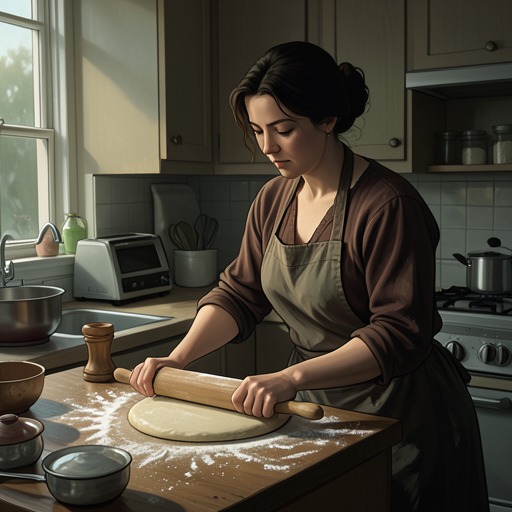
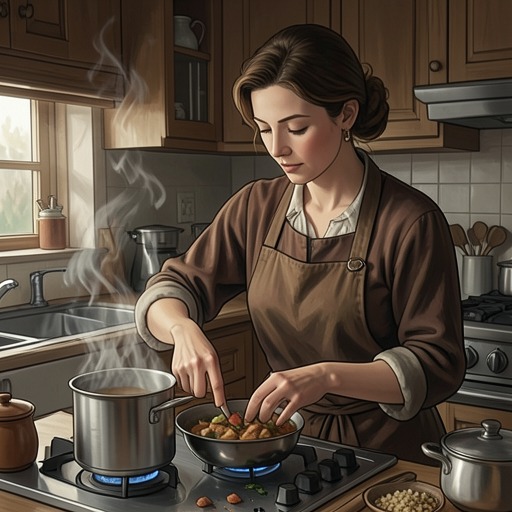
The recipe distinguishes the filling from the sauce and gives each a specific sequence of work. For the filling, onions are fried in a little oil until transparent. Ground meat, cumin, and a little sugar are added, and, after the meat browns, the cook stirs in chopped peach, apple, walnuts, raisins, almonds, and tomatoes. Salt is added, and the mixture is cooked until its liquids have evaporated. The chiles are prepared separately: they are roasted and peeled, slit down one side, and cleared of their seeds and membranes before being filled.
The sauce begins with peeled nuts ground on a stone together with cheese and cream. Salt and white pepper are added to taste. Once the filled chiles are covered with the sauce, pomegranates provide the garnish. The instructions describe a dish built through successive operations—frying, browning, seasoning, roasting, peeling, grinding, filling, and finishing—rather than through a single mixture. The final garnish is not incidental: the color of the fruit completes the visual contrast between the green chiles and white sauce.
Tita and Chencha make the banquet’s twenty-five trays together and put them in a cool place so they will remain in perfect condition for the following morning, when the waiters are to carry them in. The account gives no quantities for the ingredients, but it does make the scale and timing of the work clear. Tita is exhausted after Rosaura’s burial, which attracts few mourners because of the disagreeable odor of her body. Even so, she has to finish the walnut sauce and the banquet preparation. The movement from funeral to kitchen makes the cooking a concrete obligation undertaken amid grief, not an isolated display of culinary skill.
The wedding banquet and its effects
At Esperanza and Alex Brown’s wedding, the chiles are both visually striking and quickly consumed. Their green, white, and red colors are compared to the colors of the flag, and the trays disappear almost as soon as they are served. Tita wonders whether the guests have abandoned good manners or whether the food is simply exceptionally good. The narration leaves both possibilities in view: the guests’ appetite registers the dish’s success, while the speed with which it vanishes anticipates the banquet’s loss of ordinary restraint.
The wedding meal is explicitly contrasted with the earlier marriage of Pedro and Rosaura, where guests were overcome by food poisoning. At this celebration, the diners instead experience an intense physical and emotional response associated with desire. Gertrudis recognizes the signs first. Dancing with Juan to “My Beloved Captain,” she remembers meeting him when he was a captain and decides to leave with him before the feelings stirred by the meal go further. Her departure is followed by the other guests’ rapid excuses and exits. The newlyweds are privately pleased that the crowd has dispersed, since they can collect their suitcases and leave for the hotel.
The departure of the guests also changes the scene for Tita and Pedro. Along with John Brown and Chencha, they are left at the ranch, and John notices the intensity between Tita and Pedro. He recognizes that he has become an outsider and leaves. Tita is hurt to see him go alone; the narrator adds that he had never found someone else after she refused him. The account does not reduce the dish’s effect to an individual response: it sets off a chain of departures that empties the celebration and brings private tensions into view.
A recurring language of food
The banquet’s effects recall the earlier meal of quail in rose petal sauce. That dish had made Tita’s feelings travel through Gertrudis to Pedro, and the novel describes the process as a new system of communication in which Tita transmits, Pedro receives, and Gertrudis serves as the medium. The walnut-sauce chiles produce a related pattern of bodily intensity and desire among the wedding guests, with Gertrudis again the first to recognize what is happening. The repeated response links two distinct dishes without making them identical: each meal gives force to feelings that would otherwise remain unspoken, and Gertrudis’s recognition connects the later banquet to her earlier experience.
The dish also stands within the practical and narrative work of Tita’s cooking. After the earlier quail episode, she records instructions for arranging its garnish in Tita’s cookbook, taking care that it will not slide off-center when served. The cookbook eventually survives the fire that destroys the ranch. Esperanza finds it beneath the remains and bequeaths it to her daughter, the narrator, who says that each recipe tells a story of love. In this way, recipes preserve more than procedures: the directions for making and presenting a dish keep the remembered events associated with it available to later generations.
Inheritance and significance
The novel’s closing frame extends that inheritance into the narrator’s own kitchen. As an adult, she prepares Christmas Rolls for her birthday and recalls that her mother made them for her every year. She connects the tears that come when she cooks with Tita’s sensitivity to onions, and concludes that Tita continues to live as long as someone cooks her recipes. This final reflection does not identify the walnut-sauce chiles as the dish being prepared on that occasion, but it clarifies the larger meaning of the cookbook in which its recipe belongs: food transmits family memory through repeated preparation.
The chiles thus occupy two connected roles. They are a substantial banquet dish, prepared by Tita and Chencha through detailed labor and served to a wedding party; they are also an instrument through which feeling passes among people and alters the course of a gathering. Their tricolored presentation briefly makes the meal orderly and celebratory, while the response to eating them dissolves the formality of the wedding and sends the guests away. Preserved alongside Tita’s other recipes, the dish remains part of a record in which cooking is both domestic work and a means of carrying love, desire, and family history forward.